Wednesday, 12 October 2011

31 Million Americans Skip Breakfast Each Day

Skip BreakfastIf you Google the term "skip breakfast," more than 10 million results turn up, often with information about how eating breakfast is crucial to maintain a healthy lifestyle. Everyone may know that breakfast is the most important meal of the day, but that doesn't mean that they're all scrambling eggs and toasting bread. A recent survey by the NPD Group found that 31 million Americans, about 10 percent of the U.S. population, do not eat breakfast.
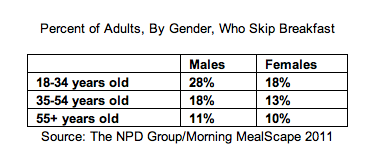
The Morning MealScape 2011 study surveyed 27,179 Americans from January 10 through March 7, 2011. The results indicated that males ages 18-34 are most likely to skip breakfast (28 percent) and females ages 55 and older were the most likely to eat a morning meal; only 10 percent reported skipping breakfast. Among children, skipping breakfast correlates with age -- teenagers are more likely to not eat breakfast than younger children. See the chart below for more statistics:
2011-10-11-Screenshot20111011at11.32.47AM.png
The most common reasons people skip breakfast were that they weren't hungry, didn't feel like eating or they were too busy. Females are more likely than males to skip a morning meal because of being busy or running late.

Sunday, 9 October 2011

Washington's most powerful woman

Hillary Clinton Hillary Clinton

Secretary of State
Last year's rank: 1

Clinton proved her diplomatic mettle -- and her influence in the White House -- by deftly steering the administration's foreign policy team through the Arab Spring, the most complex and tumultuous period on the international scene in a generation. She's also been at the center of American coordination with Europe, a key element of the Obama administration's multilateral approach.

Mobile phone: Weapon against global poverty

When renowned economist Jeffrey Sachs visited rural villages in sub-Saharan Africa in 2005, he saw impoverished communities with poor drinking water, feast-and-famine crop cycles and rampant malaria infections. What he didn't see was mobile phones.
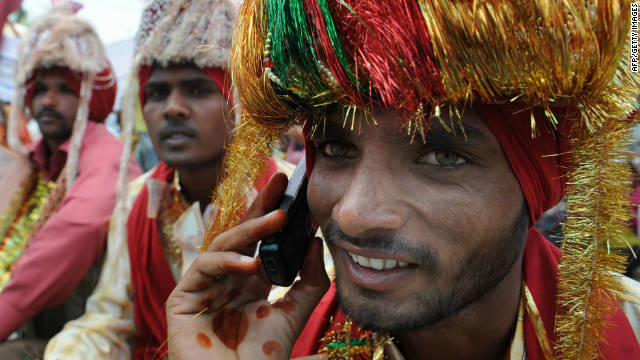
An Indian talks on his mobile phone during a mass marriage ceremony for some 525 poverty-stricken couples from the India-Pakistan border area on April 13, 2009.
"Now mobile phone ownership is perhaps 30% of households and cell phone coverage is widespread," said Sachs, director of the United Nations Millennium Villages Project, which focuses on improving 14 rural villages across 10 African countries as a model for wider prosperity in the region.
The advent of the mobile society may have brought convenience and a cultural sea change to the U.S. and Europe, but in the poorest regions of the world, affordable mobile phone access has caused a quantum leap in services -- like calling for medical help, sending a quick letter to loved ones or starting a savings account -- that Americans and Europeans have taken for granted for generations, analysts say.
A vendor of mobile phones in Lagos, Nigeria, in April 2007. The cost of cell phones have dropped in the past decade, which saw mobile subscriptions grow to 4 billion in the developing world.
"The cell phone is the single most transformative technology for development," said Sachs, head of the Earth Institute at Columbia University and author of the 2005 book "The End of Poverty."
"Poverty is almost equated with isolation in many places of the world. Poverty results from the lack of access to markets, to emergency health services, access to education, the ability to take advantage of government services and so on," Sachs said. "What the mobile phone -- and more generally IT technology -- is ending is that kind of isolation in all its different varieties."

This April 17, 2009 shows an Indian vendor using her mobile phone to take customers orders at a wholesale market on the outskirts of Hyderabad. The simple ability to make a phone call has had far-reaching economic consequences, analysts say.
Moreover, the profusion of payment services via cell phones puts places like Kenya and Uganda in the vanguard of mobile financial services. "You can walk in the middle of rural village in Rwanda and use a mobile phone to pay at a recharging station to recharge LED lights," says Amanda Gardiner, acting program manager of Business Call to Action, a New York-based non-profit organization that is helping to bring more mobile phones to Africa's rural poor.
"I'm always flabbergasted I don't walk into Home Depot and see these services here, just swipe your cell phone and go," Gardiner said. "In some ways, they're really leaping ahead of us and going right to the future."
Bengladeshi refugees from Libya recharge their cellular telephones on March 9 at the Choucha camp in Tunisia near the border with Libya. Kenya's "mobile-money" revolution
From 2005 to 2010, cell phone use tripled in the developing world to nearly 4 billion mobile subscriptions, according to the International Telecommunications Union (ITU). Nowhere was the growth faster than in Africa, which saw mobile use grow more than 400% during that time frame, according to ITU. That means more money -- a 2006 University of Michigan study found that every 10% increase in cell phone penetration grows the local economy by 0.6%.
The simple ability to make a phone call has far-reaching economic consequences, Sachs said.
A disabled beggar looks on as another beggar talks on a mobile phone in a market in Rawalpindi, Pakistan, on November 19, 2008. A 2006 University of Michigan study found that every 10% increase in cell phone penetration grows the local economy by 0.6%."Places where traditionally, people would walk livestock for a week or two without knowing what kind of price they'll fetch -- should they go to Khartoum, Nairobi or Port Saeed? Now they can call ahead and find out where to get the best price," Sachs said.
The low cost of setting up mobile towers and plunging costs of handsets has allowed cell phone coverage to grow even in poor, rural locations, said Michael Joseph, former CEO of Safaricom, a Kenyan telecom provider which grew from 17,000 users when he started in 2000 to more than 18 million when he stepped down in 2010. "There's probably more pervasive coverage in Kenya than in many areas in Europe," Joseph said.
Business models set up for selling services to the poor -- such as buying pre-paid phone service and charging by the second rather than the minute -- made cell phone use affordable, but Safaricom's development of banking services via cell phones revolutionized the telecom business in poor countries.
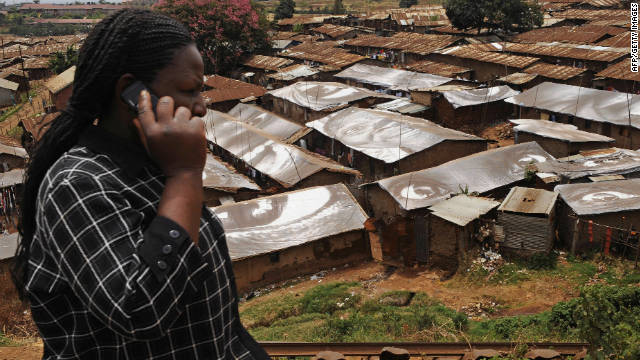
A woman speaks on a mobile phone in front of Kibera, one of the world's largest slums, on February 16, 2009, near Nairobi. Mobile phone growth in Africa has grown more than 400% from 2005 to 2010.Safaricom, in partnership with the U.K.'s Vodafone, started M-PESA (short for mobile pesa, Swahili for "money") services in 2007 that allow customers to digitally transfer cash via mobile phones. Two years later, 10% of the country's GDP was being circulated through M-PESA, according to a 2010 World Bank report. Now Kenyans make $1 billion a month in transactions via M-PESA, where cash can be deposited and transferred at one of 20,000 stores, Joseph said.
"The growth of GDP in Kenya would be half what it was the past 10 years if it wasn't for the mobile phone," said Joseph.
"About 70% of all jobs in Kenya are in the informal sector -- selling goods on the side of the road, that sort of thing -- and now to start a business all you need is a cell phone," said Joseph, who now is a fellow at the World Bank focusing on mobile money services.
As a result of M-PESA, more cash is moving -- and staying -- in smaller villages, building up the local economy, said Olga Morawczynski, who spent 18 months in Kenya studying the impact of mobile banking services there.
"Now that money is being delivered locally, they didn't have to physically go to the nearest urban center to get cash," said Morawczynski, who is now working in Uganda on mobile banking programs for the Grameen Foundation's AppLab program. "I noticed village stores had seen a demand in 'city goods' -- things you wouldn't typically get in the villages before like furniture, or a particular hair-straightening product for women.
Mobile apps for poverty
Cell phone technology has unleashed new ways to help the poor in developing countries, Sachs said, but businesses have led the way.
"Cell phones are spreading almost entirely on a market basis ... only now are we starting to get the applications for it on the social services side," Sachs said. "And the genius of prepaid phone cards has made it possible for the poor to gain access to this technology without government involvement ... it's largely governments stepping out of the way and letting commercial companies come in."

Safaricom's mobile banking model is being brought to areas from Bangladesh to Uganda. The United Nations Development Bank last month announced a program to bring mobile phone service to 3 million more poor people in Africa and South Asia by 2013. Mobile technology is now being used in Gambia to track medication stock levels in rural villages, Gardiner said. For the UN Millennium Project villages, the pre-paid mobile card is now being used as a model for pre-paid electrical service.
"We're able to do very quick mapping and needs assessments with smartphone with GIS capability," said Sachs, project director. "We can cover an area of assessment in weeks, something that used to take years."
"The most powerful thing about cell phones is how it has released money flow incountries that have poor infrastructure and often are in crisis situations," Morawczynski said.
"It also teaches people terms such as 'pin number', 'account', and 'transfer,' these kind of technical foreign terms that serve as a nice transitional toward using financial banking services for the first time. People are realizing it's better than keeping money buried in the ground."

Our future: Empty pockets, except for our phones

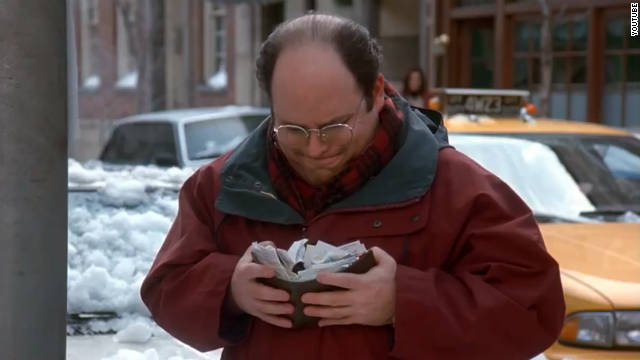
Google says the first customer for Google Wallet should be George Costanza from the '90s TV show
Google says the first customer for Google Wallet should be George Costanza from the '90s TV show "Seinfeld."

Here's a Googley vision for the future:

"We definitely hope one day you can walk out of the house with your phone in your hand -- and nothing else," said Marc Freed-Finnegan, the company's product manager for Google Wallet. It aims to digitize everything in your pockets in coming years by collapsing all that paper, plastic and metal into one device: the smartphone.
The idea of using the mobile phone as a credit card, driver's license, transit pass, digital coupon collector, house key, hotel key, corporate ID and more probably sounds pretty sci-fi-futurey. But it's almost practical when you consider the history of the smartphone.
Since the Apple iPhone debuted in 2007 (it's considered by most tech analysts to be the first true smartphone, running apps and functioning as a pocket computer), technologists have been cramming ever more functionality into these Swiss Army Knife-like gadgets.
Our phones have replaced many other once-common tools, from GPS devices (remember those?) to handheld gaming consoles, point-and-shoot cameras, calendars, notebooks, newspapers and portable music players.
Now they're conquering new territory, most notably the wallet.
From there, who knows? Analysts expect phones to get so smart that they could delay your alarm clock if an airline delays your morning flight. Apple's new "humble personal assistant," named Siri, is a step in that direction. And technologists are working on phone prototypes that could be built into clothing, could project their screens on your skin or, in the way-off future, would have flexible and stretchable screens.
"Mobile phones are definitely becoming a center of all of our lives, I think," Freed-Finnegan said. "When you're carrying around this small computer, you can do all kinds of things with it."
The phone-as-wallet trend started in South Korea and Japan about five years ago, and it's been talked about in the U.S. for some time. But it only became a reality September 19, when the Google Wallet app went public for Nexus S smartphones on Sprint's network. That's a relatively small subset of people (Google wouldn't say how many), but the company says it's just an early implementation of what's to come.
Here's how it works at checkout:
Instead of pulling out a credit card to pay for your purchase, you get out your phone. Then you tap it on an NFC reader (these are becoming more common in stores and are usually labeled "PayPass" along with a little radio-wave icon) to log the payment. You have to enter a PIN for security.
Google Wallet currently works only with Citi MasterCard. Google also has a prepaid card of its own that you can load up with money from a bank or credit card account.
Some reviewers say the service is clunky.
"Other forms of payment are easier and quicker," said Jeff Blyskal, a senior editor at Consumer Reports, who tested Google Wallet in San Francisco.
"I don't think the Google wallet or any of these digital wallets are going to replace your leather wallet," he said. "I just don't think it will happen."
The phone-wallet technology is promising and probably will be a significant part of the mobile future, but it has to get easier to use, said Will Stofega, director of mobile device technology and trends at IDC, an analyst firm.
"I think the phone as wallet is a good place to start, and one of the things that has to happen is it has to be easy ... and it has to be accepted all over," he said.
Google says Google Wallet will continue to develop. The company hopes that, at some point, this smartphone app will carry loyalty cards and digital coupons so someone could just tap their phone and, all at once, also get discounts from a grocery store loyalty program or spend a Groupon deal they had in the queue.
In the longer term, the company and others hope to jam the rest of the contents of your pockets -- identification cards, transit passes, keys and the like -- into your phone, too. The details are far from worked out, but a phone with an NFC chip could be used to unlock doors and to identify a person. (Here's one reason Google Wallet isn't all that popular yet; only a handful of smartphones in the U.S. have such a chip in them, including the Google Nexus S and two BlackBerry models, which don't work with Google Wallet.)
For a hotel key, a clerk could transfer a key permission to the guest's phone upon check-in. Then the phone would communicate with a door lock in the same way it would with a cashier: by passing identifying information back and forth and unlocking the door.
Lots of hardware and industry standards might need to be changed to make something like that happen. And there will probably be security issues as well.
Even more complicated would be the phone-based drivers' license, since state governments would need to approve that. Google said there would obviously also have to be some form of authentication technology employed so the digital license couldn't be faked. That's a long way out, Freed-Finnegan said.
But the company thinks the digital wallet is a smart place to begin.
"We're really just getting started," he said.

Saturday, 8 October 2011

Hedge Funds Are Betting Against Hungary

French and Belgian bank stocks have crashed and the bond yields of Greece, Italy and Portugal may be peaking. Now hedge funds and bond vigilantes have begun to zero in on Hungary as the fashionable European country to bet against.
One of the first countries to get bailed out by the International Monetary Fund in the early days of the financial crisis, Hungary has undergone a severe retrenchment since then with banks, consumers and the government cutting back drastically. Now, after a brief export-driven growth spurt, Hungary, like the rest of Europe, could well be headed for a second recession.
As with Greece, Spain and Italy, the Hungarian government and its large banks have been reliant on foreign investors for their borrowing needs and, as a result, the country’s foreign currency debt burden of 110 percent of gross domestic product is one of the highest in the world.

Crucially, the government sells 50 percent of its debt to foreign investors, and as worries build over the weakening of the forint and drastic antibank measures taken by the government, the bears are betting that Hungary will suffer the same foreign investor strike that led to bailouts for Greece, Ireland and Portugal.
Which may have been why Hungary’s embattled Central Bank governor, Andras Simor — who survived a concerted attempt by the prime minister, Viktor Orban, to fire him last year — made a quick visit to London this week to take the temperature of Hungary’s jittery bond holders.
Mr. Simor is fully aware that in the current risk-averse market, investors who were eager last year to hold higher-yielding Hungarian debt may no longer be willing to do so — especially in light of the controversial actions taken by the government to tax banks and, as he puts it, to “quasi-nationalize” the pension system.
“Any policy maker who says he is not concerned would be crazy,” Mr. Simor said on Thursday, referring to the recent flight to safety by emerging markets investors. “This affects countries with large amounts of debt. But I think that if investors look not at the short term but the medium term they will see that this a country that pays a reasonable rate of interest and has a reasonable budget deficit — and I think they will make the right calculation.”
Investors may well be looking to the medium term — but not in the way Mr. Simor would want them.
By purchasing credit-default swaps, which have more than doubled in the last three months, and making bets that the country’s banks and bonds have further to fall, some hedge funds are taking the view that money is going to keep fleeing the country, forcing Mr. Simor to keep rates even higher to defend his currency. Since July, the forint has weakened in value against the euro to 296, from 264 — perhaps the clearest sign that investors are losing confidence in Hungary.
Hungary has also suffered from the strong Swiss franc as loans in this currency, particularly in the mortgage market, are 20 percent of G.D.P.
While Mr. Simor was critical of some of the government’s more unconventional measures, he argued that the economy was in much better shape than it was two years ago, with a target budget deficit of just 2 percent of G.D.P. for 2012.
Because Hungary is not a member of the euro zone, a crisis would not have the systemic effect of a Greek collapse. But with the resources of the International Monetary Fund now focused on greater Europe, a Hungarian rescue operation would come at a bad time — especially as relations between the fund and the current government are strained. It is also true that large banks in Italy and Austria have significant operations in Hungary.

Where are cell phones most popular?

China's two special administration regions -- Macau and Hong Kong -- have more cell phone subscriptions per capita than anywhere else in the world.
For every 100 people in Macau, there are 206.43 cell phone subscriptions, according to recent statistics from the International Telecommunications Union. Hong Kong is second with 190.21 subscriptions for every 100 people.
China, the world's most populous nation, has the most cell phone subscriptions in the world: just more than 859 million. But there are only 64.04 subscriptions per 100 people, ranking it 150th on the list above.
The United States ranks 114th, with 89.86 subscriptions per 100 people.
At the bottom of the list is Myanmar, where there are only 1.24 subscriptions for every 100 people. North Korea is second from bottom with 1.77. Most of the bottom 25 consists of poor African countries.
Joining Macau and Hong Kong in the top five are Saudi Arabia, Montenegro and Panama.
Oil-rich countries are well-represented in the top 20, with Saudi Arabia joining Libya (9), Russia (11), Oman (12), Kuwait (14) and the United Arab Emirates (20).